

FUJINON XF400mmF4.5 R LM OIS WR x Benjamin Charles Trickey
Finding New Perspectives with the FUJINON XF400mmF4.5 R LM OIS WR
Landscape photography has always been about more than documenting a place. For me, it’s about capturing a moment in time, finding order within complexity, and discovering compositions that aren’t immediately obvious. While wide-angle lenses have long been the traditional choice, I’ve always been drawn to the unique perspective a telephoto lens offers – its ability to isolate details, compress layers of light and landscape, and transform familiar locations into something entirely new.
Over the past few months, I have photographed the diverse landscapes of Australia’s east coast, travelling through Victoria, New South Wales and Queensland – from the towering limestone formations of the Great Ocean Road to ancient rainforests, rugged mountain ranges, sweeping coastlines and the abstract patterns carved by wind, water and light. Throughout the journey, the new FUJINON XF400mmF4.5 R LM OIS WR, paired with the FUJIFILM X-H2S, were my go-to duo, giving me the opportunity to explore landscapes from a fresh perspective.

A lens that helps me connect to the landscape and the world in a different way
One of the biggest misconceptions about landscape photography is that wider is always better. Some of my favourite images are made with long focal lengths because they encourage a different way of seeing. Rather than capturing everything in front of you, a telephoto lens allows you to remove distractions and focus on the relationships between shape, texture, light and atmosphere. It reveals compositions that often go unnoticed, inviting a slower and more intentional approach to creating images.
That philosophy came to life almost immediately along Victoria’s Great Ocean Road. Standing above the Twelve Apostles at sunset, I found myself ignoring the expansive vista and instead searching for moments within the landscape. Layers of sea mist wrapping around the limestone stacks, waves colliding against weathered cliffs and subtle changes in light became the subjects themselves. The FUJINON XF400mmF4.5 R LM OIS WR’s reach let me simplify these scenes into clean, balanced compositions, far more intimate than the traditional wide-angle view.


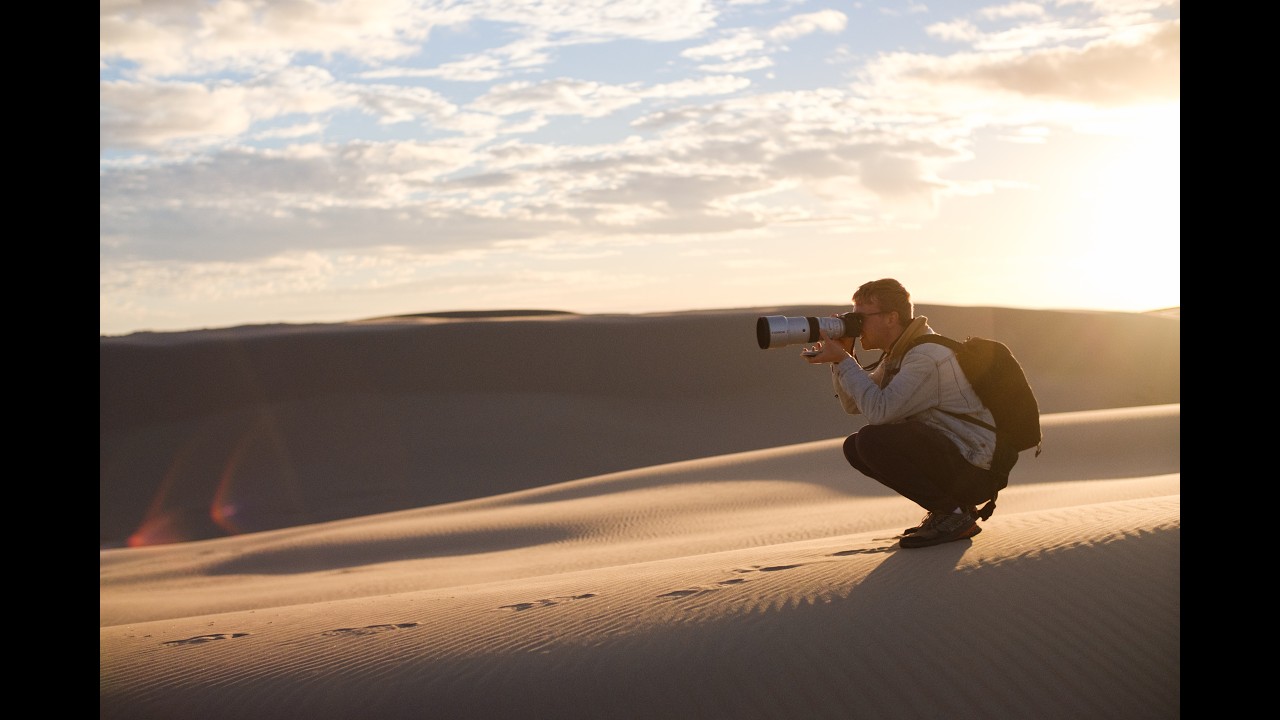
Heading north through New South Wales, that way of seeing kept evolving. At Anna Bay and Byron Bay, I isolated distant headlands beneath dramatic skies, creating minimalist seascapes that favoured mood over scale. Around Port Stephens and the Stockton Sand Dunes at Anna Bay, the landscape turned almost abstract – wind-carved patterns, repeating lines, and shifting shadows became subjects in their own right, proof that compelling images often live in the smallest details, not the grandest views. A highlight while filming the BTS video was compressing the landscape, with towering dunes leading the eye toward crashing surf in the distance. Of all the images I’ve shot in Australia, these are among my favourites.


Moving inland to New England National Park reinforced the lens’s versatility. As weather rolled across the escarpments, the FUJINON XF400mmF4.5 R LM OIS WR compressed layered mountain ridges fading into the distance, revealing a depth and atmosphere no wider focal length could match.

Queensland offered yet another perspective. Springbrook National Park’s lush rainforest provided endless opportunities to isolate intricate details, while the Glass House Mountains’ distinctive peaks became studies in shape, light and scale. Along the coast at Snapper Rocks, I switched constantly between intimate compositions and abstract studies of waves, reflections and the interaction between the ocean and the shoreline. The FUJINON XF400mmF4.5 R LM OIS WR never felt limited to one style – it adapted naturally to every environment.


What surprised me most wasn’t the lens’s optical performance, but how much its compact, lightweight design changed the way I worked.
A 400mm f/4 prime is typically synonymous with size and weight – a lens reserved for specific situations. The FUJINON XF400mmF4.5 R LM OIS WR challenged that entirely. It stayed mounted to my camera for much of the journey, whether I was hiking through rainforest before sunrise, climbing coastal lookouts, or spending hours exploring remote landscapes. Instead of thinking about the effort of carrying a super telephoto, I simply focused on creating photographs.
Why the lightweight design made a difference:
- Stayed mounted, always ready – no hesitation to bring it along or swap lenses when a shot appeared
- Handheld for longer – easier to shoot without a tripod during hikes and spontaneous moments
- Less fatigue over long days – reduced strain across multi-hour treks and climbs
- More spontaneity – freed me to chase fleeting light rather than manage gear
- Greater reach without the bulk – compression and detail of a super telephoto, without the usual trade-off in portability
That freedom fundamentally changes the creative process. When your equipment isn’t slowing you down, you’re more inclined to walk a little further, explore another track or wait a little longer for the light to change. Those decisions often lead to the images that are the most memorable.


Paired with the FUJIFILM X-H2S, the experience felt seamless. The combination was responsive, intuitive and dependable in constantly changing conditions, allowing me to concentrate entirely on composition, timing and light.
Image quality throughout the project was exceptional. Fine detail was rendered beautifully, colours stayed natural and rich, and the sharpness gave me complete confidence photographing distant landscapes. Even in challenging conditions – fog, haze, shifting light – the lens consistently delivered files with remarkable depth and detail, delivering results I could rely on throughout the project.
Looking back at this body of work, what stands out isn’t simply the locations I visited, but how differently I experienced them. The FUJINON XF400mmF4.5 R LM OIS WR encouraged me to move beyond the obvious composition and search for quieter moments within the landscape. It challenged me to simplify, to isolate and to discover images hidden inside scenes that I might once have overlooked. For me, that’s the true measure of a great lens. It’s not defined solely by specifications or technical performance, but by its ability to influence the way you see. The FUJINON XF400mmF4.5 R LM OIS WR gave me the freedom to travel lighter, explore further and approach every landscape with fresh curiosity. It quietly removed the barriers between my vision and the final image, allowing me to focus entirely on the creative process.


As photographers, we’re always searching for new ways to interpret the world around us. Sometimes, all it takes is a different perspective. Throughout this journey across Australia’s diverse landscapes, the FUJINON XF400mmF4.5 R LM OIS WR became exactly that, a lens that didn’t just capture the landscape, but inspired me to see it differently.


