Travel photographers Mathias and Annika Koch explain how they create photos that take you on a journey
At its core, travel photography is not complicated. All you need is a camera and a location. In a sufficiently jaw-dropping environment, even complete novices will come away with pretty pictures.
What takes practice and talent is not just documenting these places, but making them feel like more than a photo; something tangible, attainable. Your intention should not just be to showcase a destination, but to – in some small way – transport your viewer.
That is the aim of husband-and-wife travel photographer duo, Annika and Mathias Koch. “What we expect from ourselves is to transfer our emotions,” begins Annika. “We want to take people with us and make them feel what we felt.”
“We want them to think, ‘Okay, I could stand there, I could see that, I could get that feeling,’” adds Mathias. “‘I could be the one standing on top of that mountain.’”

Sharing a passion
“We met through our interest in travelling and photography, nine years ago,” explains Annika. “It started as a hobby, but over the years it has become our job. Now we are making a living from our photography and travelling the world.
“We got started just making memories for ourselves,” she continues. “We started to upload on Instagram for our families and friends to follow our journey. But then even more people joined us – not only friends and family, but strangers. So, we started to have higher expectations from ourselves and wanted to improve our photography skills.”
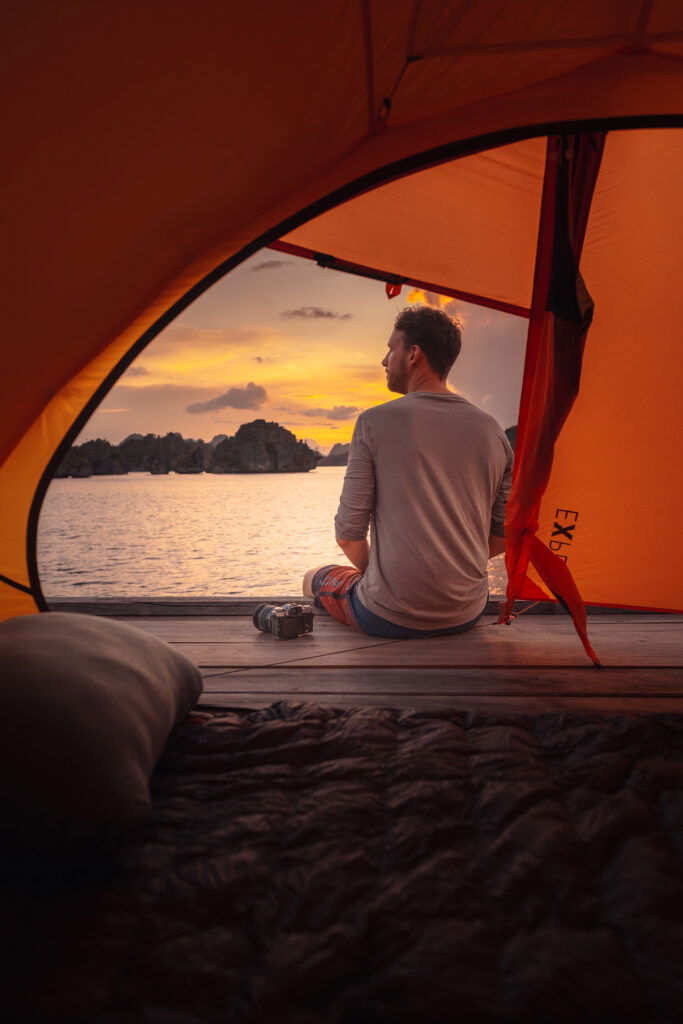
As professionals, they take a conscientious approach, ensuring they walk away from a destination with the photos they need.
“We transfer these emotions by finding the best time of day, with perfect light. So we usually work in the golden hours – right before sunset and right after sunrise,” notes Annika.
“We also try to depict real life – so we do documentary-style pictures during hikes and lifestyle stuff in the city,” Mathias remarks. “It’s a combination of nice, planned pictures, but then also spontaneous ones.”

Planning a trip
“We start by thinking, ‘What is the trip about?’” explains Annika. “For example, we just went to London and knew we wanted spontaneous pictures.
“You never know how crowded places will be, or how the lighting will look, so we like to be as flexible as possible but also lightweight. In this case, we took the FUJIFILM X100VI, which was really cool for city photography.”
“We start by going out and having a look,” says Mathias. “During the day, we will pick all these locations and then come back when the light is better.”
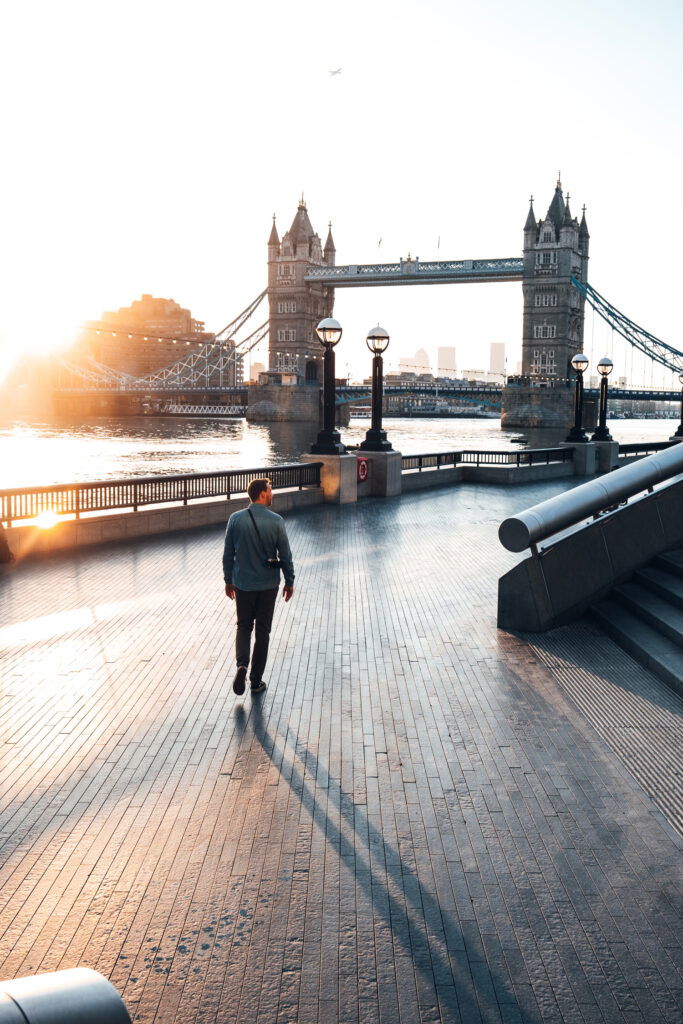
“We knew that during the day, everything is crowded. So, we woke up early, at 4:30 AM, to be at the location for sunrise,” Annika recalls. “Then, when the light was perfect and no people were around, we photographed the sunrise in front of Tower Bridge. And it was beautiful because the light was amazing and there were no other people.”
“That’s how we do it in nature as well,” adds Mathias. “We are awake incredibly early in the morning sometimes, doing a hike while it’s still dark – and then we wait for sunrise at the right spot.”

Finding inspiration
Always looking for ways to improve their own image making, the couple keep an eye on how other travel photographers encapsulate a destination.
“When looking at photos, we want to feel like, ‘Ah, I want to be there. I want to go to that place,’” enthuses Annika. “But playing with light always impresses us the most – and when time is taken to make a beautiful composition.”
“Careful use of light,” agrees Mathias, “but sometimes waiting for a foggy day for a given location is the right thing. We love when someone has caught the best conditions for that particular place.
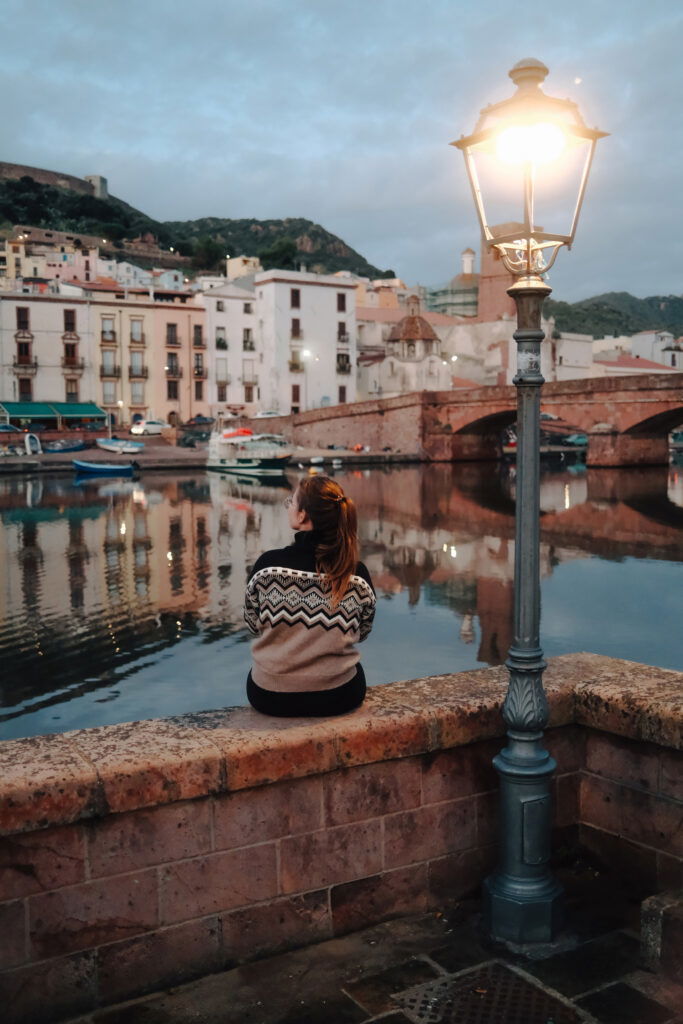
“Also, putting someone in the picture. It helps that little bit more to give that feeling of ‘Okay, I could stand there.’ If you put a person in there, you have a better feeling for the scale. Then, you can make these places look as impressive as they deserve.”
This was a technique Annika and Mathias wanted to put to use on a recent excursion.
“We were on a sea kayaking trip in the very east of Indonesia. It was so remote that there were almost no tourists,” explains Annika. “We went out there with a tiny group of people.”
“For 11 days, we didn’t see any other tourists,” Mathias notes.

“For a trip like that, we try to be as light as possible – although it’s almost never the case by the end,” laughs Annika. “For lenses, we try to bring everything from 8mm to 140mm because you never know what you can expect from the place.”
“We tend to prefer primes,” adds Mathias, “but in the example of the sea kayaking trip, a wide-angle prime or zoom is much easier. There isn’t as much flexibility from a kayak.”
“When you’re out on the water, you can’t change the lenses whenever you want,” agrees Annika. “You have to prepare everything before entering the kayak.”
“We loved using the FUJINON XF8mmF3.5 R WR here for the point-of-view photos,” enthuses Mathias. “Although we don’t use it too often in other trips, it was absolutely perfect for that scenario.”

Packing for versatility
Our most-used lenses on other trips are the FUJINON XF16-55mmF2.8 R LM WR,” continues Mathias. “We use the XF8-16mmF2.8 R LM WR and XF50-140mmF2.8 R LM OIS WR as well. Those three lenses are almost always with us.”
In terms of cameras, the couple have enjoyed a variety of X Series models.
“The FUJIFILM X-T5 is really good,” notes Annika. “With its quality and weight, it’s a fantastic travelling camera.”

“For filming, the FUJIFILM X-H2S is the best,” enthuses Mathias. “We do a lot of videos or Reels, mostly with that. We use the X-T5 for filming too, but for me the X-H2S is the perfect filming camera.”
For their trip to Indonesia, though, it was a lightweight all-rounder that won the day. “For the sea kayaking trip, I used the FUJIFILM X-S20,” Mathias adds. “It’s small, but so good. It has amazing quality.”

Always pushing
“We just had a trip to Japan where we challenged ourselves to go with the flow, without planning anything in advance,” recalls Annika. “We planned our first days in Tokyo, but beyond that it was spontaneous.
“This was mostly because it was winter, so we didn’t even know if it was worth planning ahead because of conditions and weather, but we ended up loving it.”
For Mathias, this experience gave impetus to his desire to work on new aspects of photography. “We both still have things to improve on,” he admits. “Since Japan, we’ve started enjoying street photography, so we recognise the need to work on that. It’s a new field for us, and we can feel it, but it’s getting better with time.”

“As long as it’s your passion, and you go out and do your best while improving your skills, you’re already off to a good start,” points out Annika. “That’s how we did it. We kept trying and learnt by doing – that’s the most important part.
“You have to have fun; you can’t force it,” she concludes. “If you force it, then it won’t look great at the end. You have to enjoy doing what you do – and you’ll see that come across in your pictures.”